Translate

Mostrar mensagens com a etiqueta Spybotics. Mostrar todas as mensagens

segunda-feira, 3 de fevereiro de 2025

Software original LEGO® e Hardware LEGO® - sua interação - uma reflexão

Desde do Interface A (1986) até ao Spike Essencial (2021), a LEGO® produziu software, ou solicitou colaboração na sua criação. Se no início havia vários softwares para o mesmo produto, pois o mesmo tinha uma vida útil mais longa, ou a sua comercialização mundial, na altura, tal promovia, mais recentemente o software passou a ser específico para cada produto novo, e a sua vida comercial foi encurtada. Talvez devido à evolução da minituarização e dos sistemas de comunicação, nomeadamente o Bluetooth e o WiFi., talvez devido à alteração de cablagens LEGO® (e voltagem, no caso do Interface A para o B).

Contudo, no meio deste processo, sobressai, pela positiva, o RoboLab, criado pela Tufts, pois o mesmo foi criado para o RCX (1998 a 2006), mas possibilita na sua versão 2.9.4, controlar o Interface B (datado de 1993), o Scout (1999) e sobretudo o seu sucessor, o NXT (2006 - a 2013), ou seja abarca produtos ao longo de 20 anos!!!! 

E uma última curiosidade, o carregador/transformador do Interface B (1983), servia para o RCX 1.0 e para a bateria do NXT home Edition.  

Dá que pensar... pois o investimento das escolas era mais duradouro. Fica aqui uma pequena grelha resumo:


From Interface A (1986) to Spike Essential (2021), LEGO® has produced software, or requested collaboration in its creation. If in the beginning there were several software programs for the same product, because it had a longer useful life, or its worldwide commercialization, at the time, promoted this, more recently the software became specific for each new product, and its life commercial was shortened. Perhaps due to the evolution of miniaturization and communication systems, namely Bluetooth and WiFi, perhaps due to the change in LEGO® wiring harnesses (and voltage, in the case of Interface A to B).

However, in the midst of this process, RoboLab stands out positively, created by Tufts, as it was created for the RCX (1998 to 2006), but in its version 2.9.4, it allows controlling the Interface B (dated 1993), the Scout (1999) and especially its successor, the NXT (2006 - 2013), that is, it covers products spanning 20 years!!!!

And one last curiosity, the Interface B charger/transformer (1983) was used for the RCX 1.0 and the NXT home Edition battery.

This leads us to think...... because the investment in schools was more lasting. Above is a small summary grid.

(Atualizado em 11/02/2025)

quarta-feira, 11 de novembro de 2020

Mindstorms SDK 2.5 - Recursos de programas e muito mais...

Confesso que não estou muito à vontade para vos falar sobre o Mindstorms Software Developer Kit versão 2.5. Contudo não posso deixar de o referenciar com uma página totalmente dedicada a ele, porque ele o merece. Refiro que consoante vou adquirindo maior confiança em estruturar a minha informação sobre o SDK, farei o que faço em qualquer dos meus artigos anteriores, atualizarei a informação.Não confundir o SDK 2.5 com o Scout SDK, já tratado noutro artigo específico sobre o conjunto 9735.

Este pacote de softwares e de documentos, foi liberado pela LEGO no sentido dos programadores contribuírem para a melhoria e otimização dos tijolos programáveis LEGO (PBricks), como RCX, mas sobretudo Scout, Microscout e Spybotics. Segundo o site (https://www.philohome.com/sdk25/sdk25.htm) a LEGO deixou de dar suporte técnico no seu site em 2008.

Por isso, o site de www.philohome.com e outros, continuam a manter online o Software SDK 2.5.

O que é que ele contém (pequena e reduzida referência - do site já referido): 

Contém várias documentações sobre códigos de byte RCX2 e Spybotics e LASM, bem como documentação, bibliotecas e arquivos de cabeçalho para comunicações entre PC e bloco. Também inclui firmware RCX2 (firm0328.lgo) que oferece mais capacidade ao RCX (até mesmo em versões mais antigas). Possui os executáveis VLLtest VCTest e VBTest e a ferramenta ScripEd, a qual possibilita a programação do RCX2, Scout, MicroScout e Spybot.

Contudo como há programadores interessados, aqui fica o link para fazerem download.


I confess that I am not very comfortable talking about the Mindstorms Software Developer Kit version 2.5. However, I can't help but reference him with a page totally dedicated to him, because he deserves it. I mention that as I gain more confidence in structuring my information about the SDK, I will do what I do in any of my previous articles, I will update the information.Do not confuse SDK 2.5 with Scout SDK, already dealt with in another specific article on the set 9735.

This software and document package was released by LEGO in order for programmers to contribute to the improvement and optimization of LEGO programmable bricks (PBricks), such as RCX, but above all Scout, Microscout and Spybotics. According to the website (https://www.philohome.com/sdk25/sdk25.htm) LEGO stopped providing technical support on its website in 2008.

For this reason, the website www.philohome.com and others continue to keep the SDK 2.5 Software online.

What does it contain (small and reduced reference - from the website already mentioned):

It contains several documentation about the RCX2 byte codes and Spybotics and LASM, as well as documents, libraries and header files for communications between PC and block. It also includes RCX2 firmware (firm0328.lgo) that gives the RCX more capacity (even in older versions).It has the VLLtest VCTest and VBTest executables and the ScripEd tool, which allows the programming of RCX2, Scout, MicroScout and Spybot.

However, as there are interested programmers, here is the link to download it.


A imagem que se segue reproduz o conteúdo do ficheiro readme.

The following image reproduces the contents of the readme file.


domingo, 5 de abril de 2020

Spybotics - Um robot singular e versátil - 3806/3807/3808/3809

LEGO® Spybotics , ou melhor, os conjuntos


LEGO® Spybotics, or rather, the sets


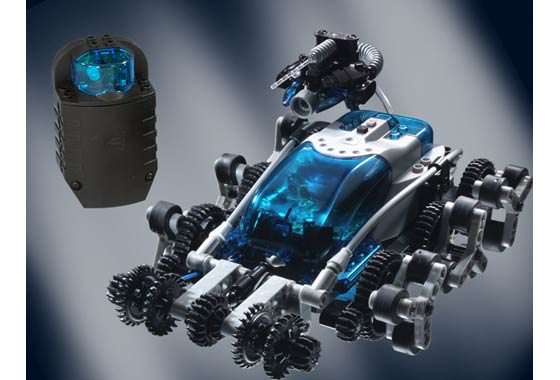
Lançados todos em 2002, e conhecidos respetivamente como o azul, o vermelho, o violeta e o verde são uns robots de uma serie da LEGO® que durante muitos anos ( e acredito que ainda agora, pois eu ainda os uso aos quatro) entretiveram jovens e não tão jovens, durante horas e horas. Sendo vendidos com um CR-ROM (único para os 4, ver mais abaixo o link) eram programados através de um cabo ligado a uma porta COM o qual comunicava com os robots através de emissão de raios de luz visível. Estes robots eram programados de diversos modos, e podiam até interagir uns com os outros nos seus movimentos, bem como interagiam com o RCX 2.0. Possuíam dois motores integrados e sensor de toque. Emitiam feixes de luz, os quais eram direcionados através de cabos de fibra ótica, os quais ao "curvarem" a luz produziam efeitos luminosos muito apelativos. Uma vez programados podiam ser controlados por um comando remoto o qual, embora internamente igual, possuía a cor transparente do robot que controlavam. 
No CD_ROM apelava-se a desafios de espionagem a nível mundial, pré-orientados, com tempo específico para a sua realização. Estes desafios poderiam ser realizados com um ou em pares de spybotics. Por fim havia a possibilidade de realizar as nossas próprias missões, e as partilhar online (na altura) que poderiam incluir mais de que um spybotics... enfim um mundo robótico aliado ao mundo lúdico do jogo.

All launched in 2002, and known respectively as blue, red, violet and green, they are robots from a LEGO® series that for many years (and I believe that even now, as I still use them at four) entertained young people and not so young, for hours and hours. Being sold with a CR-ROM (only for the 4, see the link below) they were programmed through a cable connected to a COM port which communicated with the robots through the emission of visible light rays. These robots were programmed in different ways, and could even interact with each other in their movements, as well as interacting with RCX 2.0. They had two integrated motors and a touch sensor. They emitted beams of light, which were directed through fiber optic cables, which when "bending" the light produced very appealing light effects. Once programmed, they could be controlled by a remote control which, although internally equal, had the transparent color of the robot they controlled.
The CD_ROM called for espionage challenges worldwide, pre-oriented, with specific time for their realization. These challenges could be accomplished with one or in pairs of spybotics. Finally, there was the possibility to carry out our own missions, and share them online (at the time) that could include more than spybotics ... in short, a robotic world allied to the playful world of the game.


O CD-ROM (clique na imagem para fazer download) 

Estes robots eram vendidos em caixas de cartão e não possuíam instruções de montagem em formato de livro. As instruções encontravam-s no CD-ROM que os acompanhavam, de igual modo ao CyberMaster e ao atuais WeDO. Contudo, e caso tenham dificuldade em colocar um CR-ROM a funcionar (podem fazê-lo através do uso de um programa de leitura de discos virtuais...) podem contudo ver as mesmas neste site (Japonês, por sinal). Cliquem na imagem de cada caixa.

These robots were sold in cardboard boxes and had no assembly instructions in book format. The instructions were on the CD-ROM that accompanied them, as well as the CyberMaster and the WeDO. However, and if you have difficulty getting a CR-ROM to work (you can do it using a program for reading virtual disks ...) you can nevertheless see them on this site (Japanese, by the way). Click on the image of each box.


Foi editado um livro sobre este pbrick e de como otimizar o seu uso.

A book has been published about this pbrick and how to optimize its use.


Os quatro LEGO® Spybotics -  Gigamesh G60, Technojaw T55, Snaptrax S45 e Shadowstrike S70...the meeting.....e em modo automático... uma curiosidade sobre o comportamento autónomo deste robo da LEGO®

Sobre o seu firmware e modo de configuração consulte o Mindstorms SDK 2.5 (clique aqui).


The four LEGO® Spybotics - Gigamesh G60, Technojaw T55, Snaptrax S45 and Shadowstrike S70 ... the meeting ..... and in automatic mode ... a curiosity about the autonomous behavior of this LEGO® robot

About your firmware and configuration mode see the Mindstorms SDK 2.5 (click here).


Um vídeo com os 4 spybotics


Duas fotos do interior do Spybotics


Um video onde se analisa o circuito do Spybotics


(atualizado em 17/10/2024)