Translate

terça-feira, 28 de abril de 2020

Robolab - os sets (Parte I) - O 9780... e os sets que o incluem...

Primeiro, a palavra a Chris Rogers, cocriador do Robolab. Aqui numa googletalks:


RoboLab é o nome do programa criado pela LEGO Group em parceria com a National Instruments (NI), a Tufts University e a LEGO® Education  (na época LEGO® Dacta).
Este programa educativo tinha por base o software LabView da NI.

Em contexto escolar, era necessário criar conjuntos LEGO®  com atividades base, os quais necessitariam de um conjunto de peças, livros de instruções de montagem e livros pedagógicos para uso do professor dinamizador da atividade.
Assim foram criados conjuntos de RoboLab. Estes continham peças, instruções de montagem e claro um programa para controlar o RCX que é o tijolo programável de toda esta gama.

Como RCX foi vendido em caixas individuais (a 9709), ele não estava presente nas caixas base, a não ser que a escola comprasse um conjunto especial no qual o conjunto era acompanhado por 4 RCX e respectivas torres de comunicação. Deste modo houveram pacotes específicos que continham caixas base com 4 RCX (sets 990682 [com torre USB, datado de 2002]  e 990084 [com torre porta de série]), denominado RoboLab Starter System. Estes dois conjuntos faziam-se acompanhar de igual modo de um exemplar do software RoboLab, e de 4 livros dedicados à aprendizagem da robótica (1livro "Robotic Systems - a concept guide"- 2000041) e do software (3 livros).


Concept guide - Robotic Systems
2000041
(teve 3 edições 1998, 2002 e 2005 em língua inglesa, contudo foi lançado em outras línguas)
número de impressão da 1ª edição - 4.122.191


um exemplo, a versão em sueco do Concept Guide


outro exemplo, a versão em castelhano do Concept Guide


RoboLab is the name of the program created by the LEGO Group in partnership with National Instruments (NI), Tufts University and LEGO® Education  (at the time LEGO®  Dacta).
This educational program was based on NI LabView software.

In a school context, it was necessary to create LEGO®  sets with basic activities, which would require a set of pieces, assembly instruction books and pedagogical books for use by the teacher who was responsible for the activity.
Thus RoboLab sets were created. These contained parts, assembly instructions and of course a program to control the RCX, which is the programmable brick of the entire range.

As RCX was sold in individual boxes (at 9709), it was not present in the base boxes, unless the school purchased a special set in which the set was accompanied by 4 RCX. In this way, there were specific packages that contained base boxes with 4 RCX (sets 990682 [with USB tower, dated 2002] and 990084 [with serial port tower]), called RoboLab Starter System. These two sets were also accompanied by a copy of the RoboLab software, and 4 books dedicated to learning robotics (1 book "Robotic Systems - a concept guide" - 2000041) and the software (3).
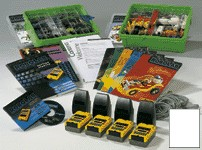


set 990084

A primeira caixa base do RoboLab é a seguinte:
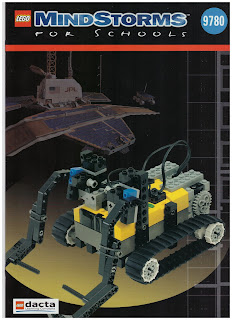
  •  9780 - RoboLab Starter Building System (1998) foi reeditado em 2001 - Conjunto muito vasto, vem em duas caixas verdes de plástico, fazia-se acompanhar de 5 livros de instruções, para cinco construções. Compunha-se de 1702 peças. Este conjunto, embora seja vendido durante anos, possui duas edições distintas que caracterizam toda a sua gama, incluindo o livro do professor. A versão denominada RoboLab (a primeira) e a versão LEGO® MindStorms for the Schools (a segunda).

The first base box of RoboLab is as follows:

 9780 - RoboLab Starter Building System (1998)was reissued in 2001 - Very large set, comes in two green plastic boxes, accompanied by 5 instruction books, for five constructions. It consisted of 1702 pieces.This set, although sold for years, has two distinct editions that characterize its entire range, including the teacher's book. The version called RoboLab (the first) and the LEGO® MindStorms for the Schools version.
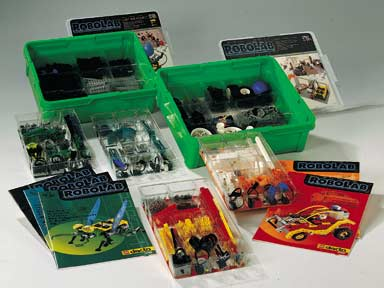

o conjunto completo (primeira versão) (foto só do conjunto 9780)


caixa 1 (primeira versão)


caixa 2 (primeira versão)


Este conjunto possibilita a realização de cinco construções. Deste modo era acompanhado por cinco livros de instruções, a saber: The Bug, The Car, the Gadget, My Home e Torbot (as primeiras imagens são da primeira edição, as imagens individuais são da segunda versão).

This set makes it possible to carry out five constructions. In this way it was accompanied by five instruction books, namely: The Bug,  The Car, the Gadget, My Home and Torbot (images are from the first edition).


as duas caixas e os cinco livros de instruções (primeira versão)


The car - 1999 and 2001 - ref: 4.178.842


The bug - 1999 and 2001 - ref: 4.178.845


The Torbot - 1999 and 2001 - ref: 4.178.841

os cinco livros de instruções da 2ª edição , 2001


Para dinamizar as atividades os professores possuíam um dossier com fichas de motivação e fichas de atividades, incluindo nestas as fichas para dar aos alunos. Este manual, com 274 páginas, era vendido em separado (primeiramente 909780, posteriormente 2009780). 
Este conjunto possibilita, com os 4 RCX recomendados, dinamizar atividades para 16 alunos. Cada grupo de 4 alunos trabalha um dos conjuntos (por isso a caixa traz as peças separadas por construções nos tabuleiros superiores), e no fim da execução das atividade A,B,C, D (ou seja 26 atividades) de cada construção (carro, insecto, casa e máquina), as contruções rodavam entre os diversos grupos, como é sugerido no próprio livro do professor. Ou seja, este conjunto possibilita um enorme recurso de aulas (sem contar com as introdutórias, que são 9, as atividades possíveis são 104, e ainda há duas de desenvolvimento finais, cada uma usando uma das caixas) para um conjunto de 16 alunos, o que é extraordinário pedagogicamente.

To streamline the activities, the teachers had a dossier with motivation sheets and activity sheets, including the sheets to give to the students. This manual, with 274 pages, was sold separately (first 909780, later 2009780).
This set makes it possible, with the 4 recommended RCX, to streamline activities for 16 students. Each group of 4 students works on one of the sets (that's why the box brings the pieces separated by constructions on the upper boards), and at the end of the execution of activities A,B,C,D (or 26 activities) of each construction (car , insect, house and gadget), the constructions rotated between the different groups, as suggested in the teacher's book. In other words, this set allows a huge resource of classes (not counting the introductory ones, which are 9, the possible activities are 104, and there are still two final development, each using one of the boxes) for a set of 16 students, which is pedagogically extraordinary.


livro do professor, as duas edições (2009780 - 
código de impressão - 4150542)


livro do professor, edição espanhol de 1999 (2009780 - ES
código de impressão - 4510511)


Foi lançado um conjunto de peças o "Bug Project Set", 
o 970676, com 83 peças.


Foi lançado um conjunto de peças o "House Project Set", 
o 970675, com 80 peças.


Foi lançado um conjunto de peças o "Car Project Set", 
o 970674, com 79 peças.


Foi lançado um conjunto de peças o "Gadget Project Set", 
o 970677, com 48 peças.


Foi lançado um quadro magnético com os icons do RoboLab para apoiar a programação
o "Robolab Icon Magnets", com um marcador (imagem com fraca qualidade).


9780 - the bug


Por fim, cabe aqui referir que todas as propostas de programação associadas às atividades deste conjunto estavam incluídas na versão do software RoboLab, bem como as dos conjuntos 9723 e 9725. Segue-se uma grelha com os conceitos chave que eram abordados no LEGO DACTA Robotics System Teacher Notes and Copymasters for set #9780.


Key Concepts in the ROBOLAB Starter System Set Activity Pack

 (page 12 of teachers book)

Este gráfico mostra quais conceitos são cobertos pelas atividades. Todas as atividades do Starter Set são organizadas em três tipos: Toda a classe (todos trabalhando juntos em uma ideia comum), Unidades (são quatro conjuntos de atividades em pequenos grupos) e temas maiores para projetos de resolução de problemas em grupos maiores. Cada atividade é rotulada por um número, por exemplo, 1, 2 e uma unidade A, B, C ou D.

This chart shows which concepts are covered by the activities. All activities in the Starter Set are organized into three types: Whole Class (all working together on a common idea), Units (these are four sets of small group activities) and larger themes for larger group problem-solving projects. Each activity is labeled by number e.g., 1, 2 and a unit A, B, C or D.

Key Concepts

Whole Class Activities

Unit 1

Unit 2

Unit 3

Unit 4

Themes

RCX Built-in programs


1A, 2A, 3A


RCX/Computer set-up


1A, 4A, 5A, 6A


Troubleshooting, debugging


6A


Simple output control (1 motor or lamp)


1A, 2A, 3A, 7A, 8A


Multiple output control (more than 1 motor or lamp)


8A

2B, 3B, 4B, 5B, 6B

2C

All

Projects 1, 2

Simple feedback (1 sensor, either touch or light)

6, 7

7A

1B, 4B

2C

All

Projects 1, 2

Multiple feedback (more than 1 sensor)

7


2B, 5B, 6B


Sensors - light

(My Home, Gadget)


5B, 8B


All

Projects 1, 2

Sensors - touch (Car, Bug, Gadget)


3A

3B


Continuous Run


2B


Loops


5C


Forks (conditionals)

6, 7


5C, 6C


Multitasking


6C


Sound and Music


5C, 6C


Projects 1, 2

Output power


1B

All

All

Projects 1, 2

Output (motor) direction


7A

1B


Projects 1, 2

Save programs


2B


Print programs


2B


Plan and implement programs


2B, 4B, 5B, 6B

2C

1D, 2D, 3D

Projects 1, 2

Design and program own inventions


5B, 6B


2D, 3D

Projects 1, 2

Using Timers


7A


Recognizing robots

1


Robotic body is related to function

2


Robots require instructions for behavior

3


Programs are instructions

4


Identify inputs and outputs

5


Sensors provide various types of input

5


Recognizing systems

6


Robotic Systems are constrained by many factors

8


Probes are devices equipped with sensors

8


Complex behavior can result from the interaction of simple rules

9


Finally, it is worth mentioning that all programming proposals associated with the activities of this set were included in the RoboLab software version, as well as those of sets 9723 and 9725.


Vídeo publicitário de divulgação do Robolab


Livrete publicitário ao LEGO MindStorms for Schools
(LEGO Educational Division - 2002)


(actualização em 23/10/2025)

quinta-feira, 16 de abril de 2020

O RCX : aspectos técnicos... (parte II)

O RCX ( Robotic Command System), o primeiro robot comercializado da LEGO Group em 1998, foi lançado em duas variáveis comerciais: a educativa e a de uso doméstico/individual, ambas da linha LEGO® MINDSTORMS®  (Mindstorms for Schools e Mindstorms, respetivamente).
A vertente educativa (primeiro LEGO® Dacta e depois LEGO® Education ), estava associada a uma linha denominada ROBOLAB (nome do programa que o monitorizava). Foi inicialmente vendido à parte numa simples caixa (9709).


RCX (Robotic Command System), the first commercialized robot from the LEGO Group in 1998, was launched in two commercial variables: educational and domestic / individual, both from the LEGO® MINDSTORMS®  line (Mindstorms for Schools and Mindstorms, respectively) .

The educational aspect (first LEGO® Dacta and then LEGO® Education ), was associated with a line called ROBOLAB (name of the program that monitored it). It was initially sold separately in a simple box (9709).


folheto inserto na caixa 9709
(4.122.204)


Posteriormente foram lançados vários sets que incluíam o RCX como parte integrante (ver grelha mais abaixo).
A vertente de uso doméstico/individual, denominada Robotics Invention System (RIS), foi paralelamente lançada e teve sempre o RCX incluído nos seus 3 conjuntos base. 
Ambas valências usavam o mesmo RCX, mas com software diferente (o RIS com o software RCX Code).
O RCX em si sofreu alterações durante os anos em que foi fabricado (1998 a 2004),. Assim existiram 3 versões, a saber: 
RCX 1.0 - O primeiro RCX possuía um adaptador que o ligava à corrente elétrica, apesar de possuir o modo de funcionamento a pilhas incorporado (6 pilhas AA). Esta ligação elétrica não carregava as pilhas caso estas fossem recarregáveis, unicamente substituía o fornecimento elétrico (das pilhas para o transformador externo);
RCX 1.0 versão 2, conhecido por RCX 1.5 - Este RCX é igual ao anterior mas já não possui a possibilidade de se ligar à eletricidade por meio de transformador. É conhecido por RCX 1.5 pois foi unicamente comercializado no set Robotics Invention System (RIS) 1.5;
RCX 2.0 - Último modelo do RCX, exteriormente idêntico ao RCX 1.5 (não possui ligação eléctrica externa), possui contudo uma alteração interna (única que se conhece)  na rádio frequência do sinal de infravermelhos. Esta alteração possibilitava a comunicação do RCX com outros robots da LEGO® entretanto comercializados como o Spybotics (ver outro post sobre este produto no separador outros robots neste blogue).
Apresento em baixo uma tabela com a indicação dos sets (educacionais ou não) que foram comercializados com este bloco programável.

Subsequently, several sets were launched that included the RCX as an integral part (see grid below).
The strand of household / individual use, called Robotics Invention System (RIS), was launched in parallel and always had the RCX included in its sets.
Both valences used the same RCX, but with different software (see future post).
The RCX itself underwent changes during the years it was manufactured (1998 to 2004). So there were 3 versions, namely:
RCX 1.0 - The first RCX had an adapter that connected it to the mains, despite having the built-in battery operation (6 AA batteries). This electrical connection did not charge the batteries if they were rechargeable, it only replaced the electrical supply (from the batteries to the external transformer);
RCX 1.0 version 2, known as RCX 1.5 - This RCX is the same as the previous one but no longer has the possibility of being connected to electricity by means of a transformer. It is known as RCX 1.5 because it was only sold in the Robotics Invention System (RIS) 1.5 set;
RCX 2.0 - Latest model of the RCX, externally identical to the RCX 1.5 (does not have an external electrical connection), however it has an internal change (the only one known) in the radio frequency of the infrared signal. This change allowed the RCX to communicate with other LEGO®  robots meanwhile marketed as Spybotics (see another post about this product in the other robots tab in this blog).
Below is a table indicating the sets (educational or not) that were sold with this programmable block.


Sobre o seu firmware e modo de configuração consulte o Mindstorms SDK 2.5 (clique aqui).

About your firmware and configuration mode see the Mindstorms SDK 2.5 (click here).

domingo, 5 de abril de 2020

Spybotics - Um robot singular e versátil - 3806/3807/3808/3809

LEGO® Spybotics , ou melhor, os conjuntos


LEGO® Spybotics, or rather, the sets


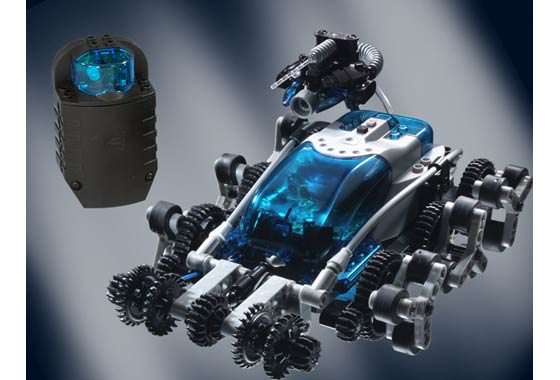
Lançados todos em 2002, e conhecidos respetivamente como o azul, o vermelho, o violeta e o verde são uns robots de uma serie da LEGO® que durante muitos anos ( e acredito que ainda agora, pois eu ainda os uso aos quatro) entretiveram jovens e não tão jovens, durante horas e horas. Sendo vendidos com um CR-ROM (único para os 4, ver mais abaixo o link) eram programados através de um cabo ligado a uma porta COM o qual comunicava com os robots através de emissão de raios de luz visível. Estes robots eram programados de diversos modos, e podiam até interagir uns com os outros nos seus movimentos, bem como interagiam com o RCX 2.0. Possuíam dois motores integrados e sensor de toque. Emitiam feixes de luz, os quais eram direcionados através de cabos de fibra ótica, os quais ao "curvarem" a luz produziam efeitos luminosos muito apelativos. Uma vez programados podiam ser controlados por um comando remoto o qual, embora internamente igual, possuía a cor transparente do robot que controlavam. 
No CD_ROM apelava-se a desafios de espionagem a nível mundial, pré-orientados, com tempo específico para a sua realização. Estes desafios poderiam ser realizados com um ou em pares de spybotics. Por fim havia a possibilidade de realizar as nossas próprias missões, e as partilhar online (na altura) que poderiam incluir mais de que um spybotics... enfim um mundo robótico aliado ao mundo lúdico do jogo.

All launched in 2002, and known respectively as blue, red, violet and green, they are robots from a LEGO® series that for many years (and I believe that even now, as I still use them at four) entertained young people and not so young, for hours and hours. Being sold with a CR-ROM (only for the 4, see the link below) they were programmed through a cable connected to a COM port which communicated with the robots through the emission of visible light rays. These robots were programmed in different ways, and could even interact with each other in their movements, as well as interacting with RCX 2.0. They had two integrated motors and a touch sensor. They emitted beams of light, which were directed through fiber optic cables, which when "bending" the light produced very appealing light effects. Once programmed, they could be controlled by a remote control which, although internally equal, had the transparent color of the robot they controlled.
The CD_ROM called for espionage challenges worldwide, pre-oriented, with specific time for their realization. These challenges could be accomplished with one or in pairs of spybotics. Finally, there was the possibility to carry out our own missions, and share them online (at the time) that could include more than spybotics ... in short, a robotic world allied to the playful world of the game.


O CD-ROM (clique na imagem para fazer download) 

Estes robots eram vendidos em caixas de cartão e não possuíam instruções de montagem em formato de livro. As instruções encontravam-s no CD-ROM que os acompanhavam, de igual modo ao CyberMaster e ao atuais WeDO. Contudo, e caso tenham dificuldade em colocar um CR-ROM a funcionar (podem fazê-lo através do uso de um programa de leitura de discos virtuais...) podem contudo ver as mesmas neste site (Japonês, por sinal). Cliquem na imagem de cada caixa.

These robots were sold in cardboard boxes and had no assembly instructions in book format. The instructions were on the CD-ROM that accompanied them, as well as the CyberMaster and the WeDO. However, and if you have difficulty getting a CR-ROM to work (you can do it using a program for reading virtual disks ...) you can nevertheless see them on this site (Japanese, by the way). Click on the image of each box.


Foi editado um livro sobre este pbrick e de como otimizar o seu uso.

A book has been published about this pbrick and how to optimize its use.


Os quatro LEGO® Spybotics -  Gigamesh G60, Technojaw T55, Snaptrax S45 e Shadowstrike S70...the meeting.....e em modo automático... uma curiosidade sobre o comportamento autónomo deste robo da LEGO®

Sobre o seu firmware e modo de configuração consulte o Mindstorms SDK 2.5 (clique aqui).


The four LEGO® Spybotics - Gigamesh G60, Technojaw T55, Snaptrax S45 and Shadowstrike S70 ... the meeting ..... and in automatic mode ... a curiosity about the autonomous behavior of this LEGO® robot

About your firmware and configuration mode see the Mindstorms SDK 2.5 (click here).


Um vídeo com os 4 spybotics


Duas fotos do interior do Spybotics


Um video onde se analisa o circuito do Spybotics


(atualizado em 17/10/2024)