...A contribution to a repository from a teacher who uses LEGO® Education equipment on a daily basis.
Note: Whenever the author obtains new information on topics already published, he updates the pages already published, not creating new ones. Use the search box to get all the information. The update date is at the end of the message.
A LEGO® através da sua Educational Products Department (futura LEGO® Dacta, e mais tarde LEGO® Education), a qual foi criada em 1980 para, de uma forma estruturada, dar apoio aos professores que por sua iniciativa usavam educativa e intencionalmente, desde de meados dos anos sessenta peças de LEGO® nas suas aulas, em 1985 apresenta pela primeira vez manuais muito bem estruturados para apoio aos docentes.
É certo que a caixa 1030, quando foi lançada, já possuía um manual de orientação (1983). Mas estes livros, muito bem ilustrados, apresentam uma qualidade pedagógica que se deve realçar, pois não só apresentam as caixas, as suas atividades e a sua interligação com o curriculum escolar, como ainda apresentam propostas de soluções, e até propostas de projetos finais abertos. E no caso do 1036 especificações técnicas sobre os componentes elétricos. Para não falar de um cartaz com o resumo das peças contidas em cada caixa seja ela a 1030, 1032 ou 1034.
Como professor, sempre olhei para os manuais educativos da LEGO® com uma curiosidade muito grande. E foi com muita satisfação que os seus manuais de STEAM, mesmo antes da expressão STEAM existir (como diz a própria LEGO®), foram sempre uma grande fonte de inspiração para as minhas aulas e para os meus alunos.
Muito obrigado, aos técnicos e professores que ao longo dos anos os produziram, ou colaboraram na sua elaboração ou na sua experimentação.
In 1985, LEGO® published the first structured educational manuals, 1035 and 1036, for sets 1030, 1032 and 1034. Why give importance to this fact?
LEGO®, through its Educational Products Department (future LEGO® Dacta, and later LEGO® Education), which was created in 1980 to provide structured support to teachers who, on their own initiative, had been using LEGO® pieces in their classes for educational purposes since the mid-sixties, presented for the first time in 1985 very well-structured manuals to support teachers.
It is true that box 1030, when launched, already had an orientation manual (1983). But these books, very well illustrated, present a pedagogical quality that should be highlighted, as they not only present the boxes, their activities and their interconnection with the school curriculum, but also present proposed solutions, and even proposals for open final projects. And in the case of 1036 technical specifications on electrical components. Not to mention a poster with a summary of the pieces contained in each box, whether it be 1030, 1032 or 1034. As a teacher, I have always looked at LEGO® educational manuals with great curiosity. And it was with great satisfaction that your STEAM manuals, even before the expression STEAM existed (as LEGO® itself says), were always a great source of inspiration for my classes and for my students.
Many thanks to the technicians and teachers who over the years produced them, or collaborated in their development or experimentation.
Os produtos da vertente educacional LEGO® que mais peso tiveram na utilização em contexto de ensino, foram e ainda são, os conjunto de máquinas simples e motorizadas, as "mesas" (interfaces) e blocos programáveis para o ensino de STEAM.
Para contribuir para elucidar, em jeito de resumo, apresento o primeiro quadro, sendo que os anos a verde referem-se aos anos em que os produtos elétricos LEGO® cuja cablagem assentava no tipo " Wire 12V / 4.5V with two Variable Color 2-prong connectors" e os anos a azul o dos em que os produtos LEGO® assentam nos conetores " Wire with Brick 2 x 2 x 2/3 Ends".
Efetivamente, a oferta LEGO® hardware vai-se alterado ao longos dos anos conforme se alteram as ligações dos seus equipamentos, e como podemos ver na imagem seguinte, sofreram já neste século várias alterações, o que por vezes incompatibiliza parcialmente o uso de um produto anterior com o seu sucessor. Constrangimentos da evolução tecnológica.... talvez.
Sendo a LEGO® um produto baseado na compatibilidade entre encaixes de peças, esta valência, refiro-me à compatibilidade entre cablagens elétricas, um "erro" cada vez mais frequente nos novos produtos LEGO® Education (a única exceção foi a migração do RCX para o NXT, com a criação de um cabo adaptador produzido pela LEGO®).
É certo que terceiros criaram cabos adaptadores, nomeadamente de Power Funtions/WeDo 1.0 para a cablagem de WeDo 2.0 e Spike, bem como cabos adaptadores de Power Funtions para NXT/EV3 (ver imagens abaixo), mas não foi a LEGO® ( Desconheço as capacidades de compatibilidade destes cabos, uma vez que mesmo sendo compatíveis fisicamente poderá haverá dificuldades de programação). Há ainda outros cabos adaptadores criados artesanalmente nomeadamente de RCX para Power Funtions (video abaixo).
Bom, fica aqui, na primeira imagem, o resumo dos anos de 1980 a 2000. Na segunda imagem, desde 2000 até 2024 .Caso haja omissões ou erros, agradeço o reparo do leitor.
The LEGO® educational products that had the most weight in use in a teaching context were, and still are, the set of simple and motorized machines, and the "tables" (interfaces) and programmable blocks for teaching STEAM.
To help clarify, as a summary, I present the following table, with the years in green referring to the years in which LEGO® electrical products whose wiring was based on the type " Wire 12V / 4.5V with two Variable Color 2-prong connectors" and the years in blue are those in which LEGO® products are based on " Wire with Brick 2 x 2 x 2/3 Ends" connectors.
In fact, the LEGO® hardware offer has changed over the years as the connections of its equipment change, and as we will see in the next post, it has already undergone several changes this century, which sometimes makes the use of a previous product partially incompatible. with his successor. Constraints of technological evolution.
As LEGO® is a product based on compatibility between fittings of pieces, this aspect, I am referring to, compatibility between electrical wiring, an increasingly frequent "error" in new LEGO® Education products (the only exception was the migration from RCX to NXT , with the creation of an adapter cable).
It is true that third parties created adapter cables, namely Power Funtions/WeDo 1.0 for the WeDo 2.0 and Spike cabling, as well as Power Functions adapter cables for NXT/EV3 (see images below), but it was not LEGO® (I don't know the capabilities compatibility of these cables, since even though they are physically compatible there may be programming difficulties). There are also other adapter cables created by hand, namely from RCX to Power Functions (video below).
Well, here, in the first image, is a summary of the years 1980 to 2000. In the second image, from 2000 to 2024. If there are omissions or errors, I would appreciate the reader's correction.
Cabo LEGO® adaptador de RCX para NXT
Cabo Firgelli adaptador de Power Funtions para NXT/EV3
Cabo adaptador de Power Funtions/WeDo 1.0 para WeDo 2.0/Spike
Video de criação de cabos RCX para Power Functions
1030 - Foto da LEGO, sobre este produto, ainda numa fase inicial
(caixa e fichas com aspecto diferente muito do produto comercial)
Em 1982 a LEGO, com a sua divisão recém criada, a Educational Products Department, lança o seu primeiro set de Máquinas Simples, e que terá um sucesso estrondoso, o Technic I -1030. Este set será produzido até 1997, daí ter tido diversas edições e reedições. Em 1984 a Worlddidac Foundation, na sua primeira edição para distinguir a inovação em material didático, atribuíu o prémio "Gold Award" a este conjunto 1030, Technic I Simple Machines Set. Nesta mesma primeira edição, a LEGO receberia de igual modo o "Silver Award" para o conjunto 1053, School Project Set.
Mas voltemos ao início de tudo, o conjunto 1030, o Technic I Simple Machines Set. Este conjunto, pensado para uso de dois alunos, com 179 peças (incluindo rodas dentadas, polias, etc) e acompanhado com 20 cartas, com instruções passo-a-passo para a construção de 29 modelos, oferecia ainda a possibilidade de 23 desafios (sem instruções). As primeira 10 fichas são de atividades mais simples (grau de dificuldade a apartir dos 7 anos) e as restantes exigem capacidades superiores /grau de dificuldade a partr dos 9 anos). A sua caixa preta (primeiro produto com esta caixa) com divisórias amarelas era encimada por uma tampa transparente que servia de apoio às instruções em sala de aula.
Desenhado para ser utilizado como conjunto de inicialização desde dos mais novos aos mais velhos (3ª ao 9º) tinha como objectivo a oferta de atividades introdutórias às máquinas simples, independentemente da idade. Foi o "primeiro e grande antepassado" dos conjuntos de máquinas simples e de STEAM atuais e teve um grande sucesso nas escolas. Foi o primeiro e único produto global LEGO educational durante 11 anos para o ensino de máquinas simples e estruturas. Teve o seu primeiro contributo pedagógico escrito (manuais vermelhos) em 1982, reformulado em 1985 e depois ampliado em 1990. É impar em importância na história da LEGO, na sua divisão educacional.
In 1982, LEGO, with its newly created division, the Educational Products Department, launched its first set of Simple Machines, which was a resounding success: the Technic I -1030. This set was produced until 1997, and has had several editions and reissues. In 1984 the Worlddidac Foundation, in its first edition to distinguish innovation in teaching material, awarded the "Gold Award" to the 1030 set, Technic I Simple Machines Set In this same first edition, LEGO would also receive the "Silver Award" for the set 1053, School Project Set.
But let's go back to the beginning, set 1030, the Technic I Simple Machines Set. This set, designed for use by two students, with 179 pieces (including gears, pulleys, etc.) and accompanied by 20 cards with step-by-step instructions for building 29 models, also offered the possibility of 23 challenges (without instructions). The first 10 cards are simpler activities (difficulty level from age 7) and the rest require higher abilities (difficulty level from age 9). Its black box (the first product with this box) with yellow dividers was topped by a transparent lid that served as a support for classroom instructions.
Designed to be used with a startup set from the youngest to the oldest (3rd to 9th) it was intended to offer introductory activities to simple machines, regardless of age. It was the "great ancestor" of today's simple and STEAM machine sets and had great success in schools. It was the first and only global LEGO educational product for 11 years for teaching about simple machines and structures.His first written educational contribution (manuals) was in 1982, revised in 1985 and then expanded in 1990. He is unique in importance in the history of LEGO, in its educational division.
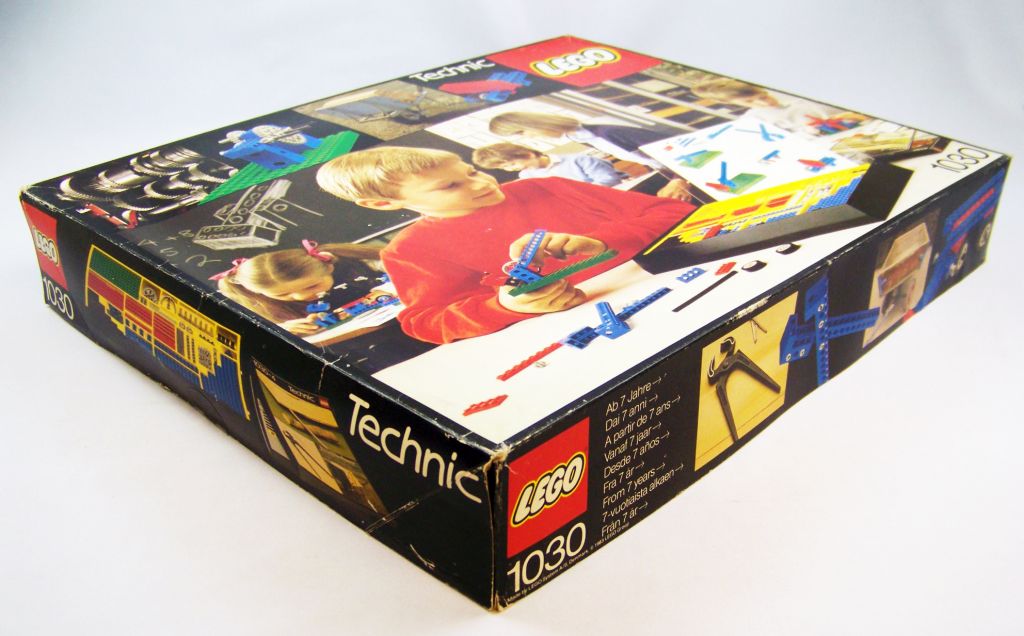
1030 - a caixa exterior (1983)
1030 - outra edição de 1983
(esta caixa possui a indicação da quantidade de peças no rosto da tampa)
(Esta caixa de cartão exterior, com cor de fundo preto, apresenta ao longo dos anos (até 1990) diferenças no arranjo gráfico nas suas diversas edições. A mais relevante é a indicação, de que a primeira caixa não contém, da tampa de "178 interlocking pieces" no canto inferior esquerdo que surge na segunda. Sem grande margem para dúvidas, esta edição é posterior à caixa apresentada acima, embora ambas indiquem 1983. Relativamente à caixa de plástico (preta e amarela) esta também apresenta pequenas alterações funcionais (quer na estrutura preta quer no tabuleiro amarelo), como reentrancias para melhor retirar as peças no tabuleiro amarelo (há pelo menos 3 versões) e duas versões na parte preta. Desconheço ainda a edição de 1982. Note-se, em jeito de resumo que a primeira edição de 1983, é acompanhada pelo livro do professor vermelho, e as fichas estão contidas numa caixa preta, sem qualquer indicação de texto no seu verso. As edições posteriores, quer a caixa de cartão preta, quer as das instruções, apresentam referências a normas de segurança.)
(This outer cardboard box, with a black background, has shown differences in its graphic design across its various editions over the years (up to 1990). The most relevant difference is the indication, which the first box does not contain, of the "178 interlocking pieces" lid in the lower left corner that appears in the second. Without much doubt, this edition is later than the box shown above, although both indicate 1983. Regarding the plastic box (black and yellow), it also presents small functional alterations (both in the black structure and in the yellow board), such as recesses for better removal of the pieces in the yellow board (there are at least 3 versions) and two versions in the black part. I am still unaware of the 1982 edition. Note, in summary, that the first edition of 1983 is accompanied by the red teacher's book, and the tokens are contained in a black box, without any text indication on its back. Later editions, both the black cardboard box and the instruction boxes, include references to safety standards.)
1030 - a caixa exterior aberta
(edição 1983 mais antiga)
(com livro do professor, edição francesa)
1030 - conteúdo da caixa exterior aberta
(com livro do professor, edição francesa)
1030 - a caixa de trabalho
1030 - as peças
1030 - A reedição, em caixa branca da LEGO DACTA
(marca entretanto criada em 1989, substituindo a marca
Educational Products Department - há mais do que uma versão desta caixa )
1031 - Activity Card Pack -1983
os livros de instruções da 1030 originais (cor preta)
(Conheço pelo menos 3 edições da caixa e duas de fichas pretas. Quanto às caixas, existe uma com o verso totalmente preto
e em 1984, há duas versões com texto em 12 línguas. Quanto às fichas em si, as diferenças mais significativas são as diferenças no rosto da ficha 1, 4 e 7 entre as duas versões pretas. Eventualmente ainda há uma mais antiga, de 1982 (?) em que a denominação deste conjunto é 1030 e não 1031)
1031 - Activity Card Pack - versão de 1989
(clique na imagem para aceder às 20 instruções na edição LEGO Dacta - 1990 (cor azul)
Há ligeiras alterações gráficas entre as edições de cor preta e de cor azu. Mesmo dentro da edição azul, há também diversas edições)
(Click on the image to access the 20 instructions in the LEGO Dacta - 1990 edition (blue color)
There are slight graphical differences between the black and blue editions. Even within the blue edition, there are several variations.)
video de apresentação do 1031 (cor preta)
1030/1031 - Imagem do conjunto
(sem livro do professor nem do curriculum)
Teacher 's Guide to LEGO Technique 1
(Não "Technic" mas "Technique" na versão original de 1982
- não possui argolas, é agrafado - Austrália )
Livro do Professor para LEGO Technic 1
(48 pag - versão francesa)
data de edição 1983
A versão de 1983 apresenta pequenas alterações no texto face à de 1982
Penso que deverá ter saído em 12 línguas este livro, repito, penso.
Livro do Professor para LEGO Technic 1
(versão inglesa)
data de edição 1983
Livro do Professor para LEGO Technic 1
(versão finlandesa)
data de edição 1983
Livro do Professor para LEGO Technic 1
(versão alemã)
data de edição 1982
1035 - Teacher´s Guide to Technic I
livro com 48 páginas
(1985 - versão UK- código de impressão 107603 GB)
Penso que deverá ter saído em 20 línguas este livro, repito, penso.
versão francesa
versão holandesa
versão dinamarquesa
versão LEGO DACTA inglesa de 1990 (?)
versão LEGO DACTA holandesa de 1990 (?)
Construções propostas
Ficha 3 - rigidez das estruturas
Ficha 4 - alavancas
1031 - 4A
1031 - 4B
1031 - 4C
(em construção)
999 - Simple Machines Curriculum
(versão inglesa)
Livro com 102 páginas, desenvolvido por professores do Minnesota, inclui 12 lições completas,
juntamente com modelos de estudo e folhas de revisão. Data da 1ª edição (?) desconheço contudo estava já disponível em junho de1987.
(a primeira foto é da edição da LEGO Educational Division, a segunda foto é da edição Lego Dacta).
Em 1987 foi editado, como propaganda, uma pequena atividade extraída desta caixa 1030, numa caixa com o símbolo da divisão educativa da LEGO da altura, o mocho. Em baixo, uma imagem do exterior da caixa e a seguir, uma imagem do seu conteúdo.
Já depois de ser criada a LEGO Dacta e de ter saído o set 9603, foi editado, ainda como propaganda, uma pequena atividade extraída desta caixa 1030. Em baixo, uma imagem da carta de apresentação do set e a seguir, uma imagem do seu conteúdo.
Para complemento deste conjunto 1030 foram lançados os conjuntos 1300/1/2/3/4/5/6/7/8/9/10/11, os quais poderiam ser adquiridos em conjunto no item 1313.
Lego 1300
Lego 1301
Lego 1302
Lego 1303
Lego 1304
Lego 1305
Lego 1306
Lego 1307
Lego 1308
Lego 1309
Lego 1310
Lego 1311
Lego 1313
O Technic I Ativity Center (9603), lançado em 1990 era adequado para a utilização do conjunto 1030, mas em idades de escolariedade mais baixas. Era composto por uma maleta com 110 cartas (versão US -20 verdes - descoberta/ 20 azuis de investigação orientada (ou seja, as do conjunto 1031) /30 amarelas - análise de objectos técnicos /40 vermelhos - invenção /7 cartões com as áreas curriculares (versão inglesa)) e dois livros: o "Technic I Activity Center Teacher's Guide"(144 páginas) e o " Technic I Activity Center Teacher's Supplement" (com 24 páginas). O Centro de Atividades Technic I e os 110 cartões de atividades são separados por tipos de atividades (Descoberta, Investigação orientada, Análise de objectos do mundo real e Invenções) e referenciados cruzadamente para uso em seis áreas do currículo das ciências físicas. O Guia do professor e o Suplemento possuem informações específicas relacionadas a cada atividade, juntamente com possíveis ideias de solução.
The Technic I Activity Center (9603), released in 1990, was suitable for use with the 1030 set, but at younger school ages. It consisted of a case with 110 cards (US version - 20 green - discovery / 20 blue - guided investigation (i.e., those from set 1031) / 30 yellow - analysis of technical objects / 40 red - invention / 7 cards with curriculum areas (English version)) and two books: the "Technic I Activity Center Teacher's Guide" (144 pages) and the "Technic I Activity Center Teacher's Supplement" (24 pages). The Technic I Activity Center and the 110 activity cards are separated by activity types (Discovery, Guided Investigation, Analysis of Real-World Objects, and Inventions) and cross-referenced for use in six areas of the physical science curriculum. The Teacher's Guide and Supplement contain specific information related to each activity, along with possible solution ideas.
Technic I Ativity Center (9603) - 1990
Os livros
"Technic I Activity Center Teacher's Guide"
páginas 144
"Technic I Activity Center Teacher's Guide"
páginas 144 . ref. ediçãoFR - F116305
" Technic I Activity Center Teacher's Supplement"
páginas 24
" Technic I Activity Center Teacher's Supplement"
páginas 24 . ref. edição FR - F117605
As fichas
Os temas (Ed francesa)
fichas verdes (ed. francesa)
fichas amarelas (ed. francesa)
fichas vermelhas (ed. francesa)
Video de apresentação do 9603
Com base no sucesso das Máquinas Simples, o Educational Products Department apresenta as Máquinas Motorizadas, que alargam os conceitos de máquinas simples adicionando motorização. Assim é lançado o conjunto 1032 (1985), o Technic II Motorized Machine Set. Este conjunto, pensado de igual modo para uso de dois alunos, com 278 peças (incluindo motor 4,5 v e compartimento de pilhas) e acompanhado com 20 cartas, com instruções passo-a-passo para a construção de 40 modelos, oferecia ainda a possibilidade de 30 desafios apresentados com fotografias/instruções. De igual modo a sua caixa preta com divisórias azuis, era encimada por uma tampa transparente que servia de apoio às instruções em sala de aula. Foi desenhada para ser utilizada como um conjunto de extenção e, sobretudo, de introdução à motorização, daí mais apta para alunos mais velhos.
Building on the success of Simple Machines, the Educational Products Department introduces Motorized Machines, which expand the concepts of simple machines by adding motorization. Thus, set 1032 (1985), the Technic II Motorized Machine Set, was launched.. This set, designed in the same way for the use of two students, has 278 parts (including 4.5 engine and battery compartment) and comes with 20 cards, with step-by-step instructions for building 40 models, it also offered the possibility of 30 challenges with instructions. Likewise, its black box with blue dividers was topped by a transparent lid that served to support classroom instructions. It was designed to be used as an extension set and, above all, as an introduction to motorization, hence more suitable for older students.
1032 - a caixa exterior
(há pelo menos duas edições desta caixa,
as imagens seguintes mostram uma das diferenças das mesmas fácil de identificar
- a lateral esquerda da tampa )
(A primeira imagem é a da versão de 1985)
1033 - Activity Card Pack
os livros de instruções da 1032
(conheço uma edição, a de 1985, com o verso com texto em 12 línguas )
(clique na imagem para aceder às 20 instruções originais)
Posteriormente foi editado, como propaganda, uma pequena atividade extraída desta caixa 1032, numa caixa com o símbolo da divisão educativa da LEGO da altura, o mocho. Em baixo, uma imagem do exterior da caixa e a seguir, uma imagem do seu conteúdo.
a caixa
o conteúdo da caixa
a ficha para a atividade
a atividade no manual do professor
Para complemento e apoio, destes conjuntos foi editado o "Technic teacher's Set" (1034, e posteriormente saiu o set 9605, para substituição deste em 1990 como é referido em documentação oficial, pois desconheço reedição da 1034 com o logotipo LEGO Dacta), o qual possibilitava ao professor repor peças aos alunos e criar um largo conjunto de modelos onde poderia previamente testar as atividades desenvolvidas pelos alunos que utilizavam os conjuntos 1030 e 1032. Esta caixa com 1516 peças corresponderia às caixas do 1030 e do 1032 juntas, e ainda mais 600 peças aproximadamente, e continha os livros do professor 1035 e 1036.
To complement and support these sets, the "Technic Teacher's Set" (1034, and later set 9605 was released to replace it in 1990, as mentioned in official documentation, since I am unaware of any reissue of 1034 with the LEGO Dacta logo) was released. This set allowed the teacher to replace pieces for the students and create a large set of models where they could previously test the activities developed by the students using sets 1030 and 1032. This box with 1516 pieces corresponded to the boxes of 1030 and 1032 combined, plus approximately 600 more pieces, and contained the teacher's books 1035 and 1036.
"Technic teacher's Set" (1034)
Existem, pelo menos, duas versões da caixa exterior em cartão de cor preta (1034). A inicial de 1985 e uma uma outra mais tardia. Podem ser distinguidas pelo seu lado lateral esquerdo onde, no lugar das imagens das caixas 1030 e 1032 surge o conteúdo deste set.
There are at least two versions of the black cardboard outer box (1034). The initial one from 1985 and a later one. They can be distinguished by their left side where, instead of the images from boxes 1030 and 1032, the contents of this set appear.
Set 1034 (1985)
set 1034, de data posterior
set 1034 e o seu conteúdo
"Technic teacher's Set" (9605)
A reedição, em caixa branca da LEGO DACTA
(marca entretanto criada em 1989)
set 9605 e o seu conteúdo
Cartaz para verificação das peças em sala de aula
dos conjuntos 1030, 1032 e 1034/9605 incluído nos livros 1035 e 1036,
como apêndice.- 108517-USA
Um conjunto complementar, um pouco ao modo do 1034, era o "Technology Resource Set"- 9609, conjunto lançado em 1994 e reeditado dois anos mais tarde, composto por 1738 peças.
Conjunto 9609 edição de 1994 - visão de conjunto
Conjunto 9609 edição de 1996
video de apresentação do set 9609
Foi lançado e divulgado/vendido por parceiros da LEGO um livro (145 páginas) com propostas de atividades para o conjunto 1030 denominado "Brick Layers: Creative Engineering with LEGO Constructions"
Foi posteriormente (2000) reeditado e muito enriquecido na versão "Brick Layers II: Creative Engineering with LEGO Constructions", livro agora com 160 páginas.
Nos Países Baixos foi editado em 1988 um manual de apoio, "Bouwstenen voor Techniek, Werkbladen voor deonderbouw van het Voortgezet Onderwijs" (Elementos básicos da tecnologia: fichas de exercícios para os primeiros anos do ensino secundário.), de autoria de de Henk van Lienen e Jan Spronkers e ilustrações de Henk van Lienen, com atividades para as caixas 1030 e 1032.
Bouwstenen voor Techniek, Werkbladen voor deonderbouw van het Voortgezet Onderwijs
Manual, de Henk van Lienen e Jan Spronkers - ilust. de Henk van Lienen.
(clique na imagem para download)
Este manual era apoiado pelo "Bouwstenen voor Techniek, Werkbladen voor de Bassisschool/Spepeciaal Onderwijs (Proefkatern)", (Blocos de Construção para Tecnologia, Fichas de Atividades para o Ensino Básico/Educação Especial (Exemplo do opúsculo)), o qual possuía um conjunto de 16 desafios em torno da ficha 12 do conjunro 1031. No fim do mesmo existia as soluções para os desafios. Conheço este manual, com 10 cadernos de teste, onde eventualmente se retiraria a última página, oara que os alunos não acedessem às soluções. O material promocional que a LEGO, através da sua divisão educacional, oferecia refere-se a este exercício (ver mais acima neste post, a caixa amarela)
"Bouwstenen voor Techniek, Werkbladen voor de Bassisschool/Spepeciaal Onderwijs (Proefkatern)
Exemplo do opúsculo
(clique na imagem para download)
Bouwstenen voor Techniek
LEGO Nederland BV Grootegast
1991
ISBN: 90-5257001-9
"LEGO Technic 1, informações úteis para o conjunto 1030"
23 páginas, 1992
"Techniek Spelenderwijs, om het spel en de knikkers"
196 páginas, 1993
(edição da Fundação O+O em parceria com a Lego Dacta)
"Techniek Spelenderwijs, om het spel en de knikkers"
196 páginas, 1993 - outra edição
(edição da Fundação O+O em parceria com a Lego Dacta)




.jpg)
.heic)
.webp)


.webp)
.jpg)


.webp)
.webp)
.webp)


